Dynamics 365
 Power Platform
 Dynamics
 Cloud & Productivity
Economic impact of staying on Dynamics GP: The hidden costs of waiting to migrate

Microsoft has published a clear end-of-support path for Dynamics GP, and the timeline is now a business planning issue, not just an IT concern. Many organizations know they will eventually migrate. The question is when to move to avoid higher costs, tighter timelines, and increased risk as the deadline approaches.
This article explains the economic impact of staying on Dynamics GP and why waiting often costs more than expected. You will learn how declining migration incentives, rising maintenance and infrastructure costs, limited partner capacity, and delayed automation and AI gains can compound over time.
What is Microsoft Dynamics GP?
Microsoft Dynamics GP, often referred to as Great Plains, is a legacy enterprise resource planning (ERP) system designed for small to mid-sized businesses. Microsoft has offered Dynamics GP since the early 2000s as a standalone ERP platform focused on financial control and operational management. Most organizations run Dynamics GP on-premises or in a hosted virtual machine, using traditional server infrastructure and SQL databases. Understanding what Dynamics GP is and how it was designed is essential when evaluating the economic impact of staying on Dynamics GP.
Dynamics GP provides core ERP capabilities, including general ledger, accounts payable, accounts receivable, cash management, fixed assets, distribution, manufacturing, and project accounting. The system was historically licensed on a perpetual model, with customers paying annual Enhancement or Advantage plan fees for support and updates. It was built for a traditional IT environment that requires server maintenance, database management, periodic upgrades, and internal or partner-led support.

Dynamics GP roadmap and support timeline
Microsoft has officially announced the end of life for Dynamics GP, confirming a phased roadmap that leads to full product retirement. After decades as a core ERP platform for small and mid-sized businesses, Dynamics GP will stop receiving product enhancements, regulatory updates, and technical support after December 31, 2029. Security updates will continue only until April 30, 2031. These deadlines define the long-term economic impact of staying on Dynamics GP because they establish a fixed timeline for when Microsoft support ends.
When product support ends in December 2029, it means no new features, no regulatory or tax updates, no service packs, and no technical assistance from Microsoft. After April 30, 2031, even security updates stop, and subscription billing and SPLA usage terminate. Organizations that remain on GP after these milestones will operate an unsupported ERP system, increasing audit exposure, cybersecurity risk, and reliance on partner-based support. Over time, this significantly increases the economic impact of staying on Dynamics GP, as costs become less predictable and risk mitigation becomes more expensive.
Key Dynamics GP roadmap dates:
- April 1, 2025: Sales for new perpetual licenses ended
- April 1, 2026: End of sales for new subscription licenses
- December 31, 2029: End of product enhancements, regulatory updates, service packs, and technical support
- April 30, 2031: End of security updates and official end of life for Dynamics GP
These dates are not flexible. They represent a defined sunset of the platform that increases financial and operational pressure over time.


Plan your Dynamics GP migration
Dynamics GP support deadlines are fixed, but your migration timeline is not. A short planning session can help you confirm key dates, risks, and the best path to Business Central based on your current GP setup and customizations.
What is the economic impact of staying on Dynamics GP?
The economic impact of staying Dynamics GP refers to the total financial effect of remaining on the platform. It includes direct costs such as rising maintenance fees, infrastructure refresh cycles, IT labor, and upgrade projects required to keep an on-premises ERP stable and secure.
It also includes opportunity costs that are harder to see in a budget line item, such as shrinking migration incentives, limited partner capacity that can extend timelines, and delayed access to automation, Microsoft 365 integration, and AI productivity gains available in modern cloud ERP platforms. Together, these factors compound over time and increase the true cost of waiting.
Microsoft licensing changes are increasing the cost of staying on Dynamics GP
As Dynamics GP approaches end of life, Microsoft’s licensing structure is changing in ways that increase the financial impact of delaying migration. Transition incentives have steadily declined, while annual maintenance costs on GP continue to rise. Over time, this creates a widening cost gap between moving earlier and waiting longer.
Together, shrinking migration discounts and increasing service plan percentages mean that from a licensing perspective, the cost of staying on GP is compounding.
Microsoft incentives for Dynamics GP migration are shrinking
Another critical factor in the financial impact of delaying Dynamics GP migration is Microsoft’s declining transition incentives. Over the past several years, Microsoft has steadily reduced the discount offered to Dynamics GP customers migrating to Dynamics 365 Business Central. The financial benefit of moving early has been shrinking.
In 2021, eligible GP customers could receive a 60% discount on Business Central licenses when transitioning off GP. That incentive was later reduced to 40% under updated transition programs. Today, the published Bridge to the Cloud 3 program reflects a 30% discount, lower than previous offerings. While Microsoft does not publicly guarantee future changes, the historical pattern is clear: incentives are decreasing over time, not increasing.

The trend shows a 50% reduction in available incentive value compared to 2021. Organizations that delayed migration have already seen materially smaller funding support.
This matters because license costs represent a measurable portion of the transition investment. When incentives decline, the net cost of migration increases. As those discounts shrink, the economic impact of Dynamics GP grows—not because GP becomes more expensive overnight, but because the opportunity to migrate at a lower cost disappears.
Rising GP enhancement and advantage plan costs
A growing component of the economic impact of Dynamics GP is the steady increase in annual Microsoft maintenance fees. Most GP customers maintain support through either the Microsoft Enhancement Plan or the Advantage Plan. These service plans provide access to updates, hotfixes, and technical support while support still exists. However, the percentage cost of both plans has increased every year since 2021.
The increases may look incremental at first glance, but they compound over time. In 2021, the GP Enhancement Plan was 16% of the license value. By 2026, it reaches 20%. The GP Advantage Plan increased from 18% in 2021 to 22% in 2026. That represents a 25% increase in maintenance cost over five years for the Enhancement Plan and a similar proportional increase for the Advantage Plan.
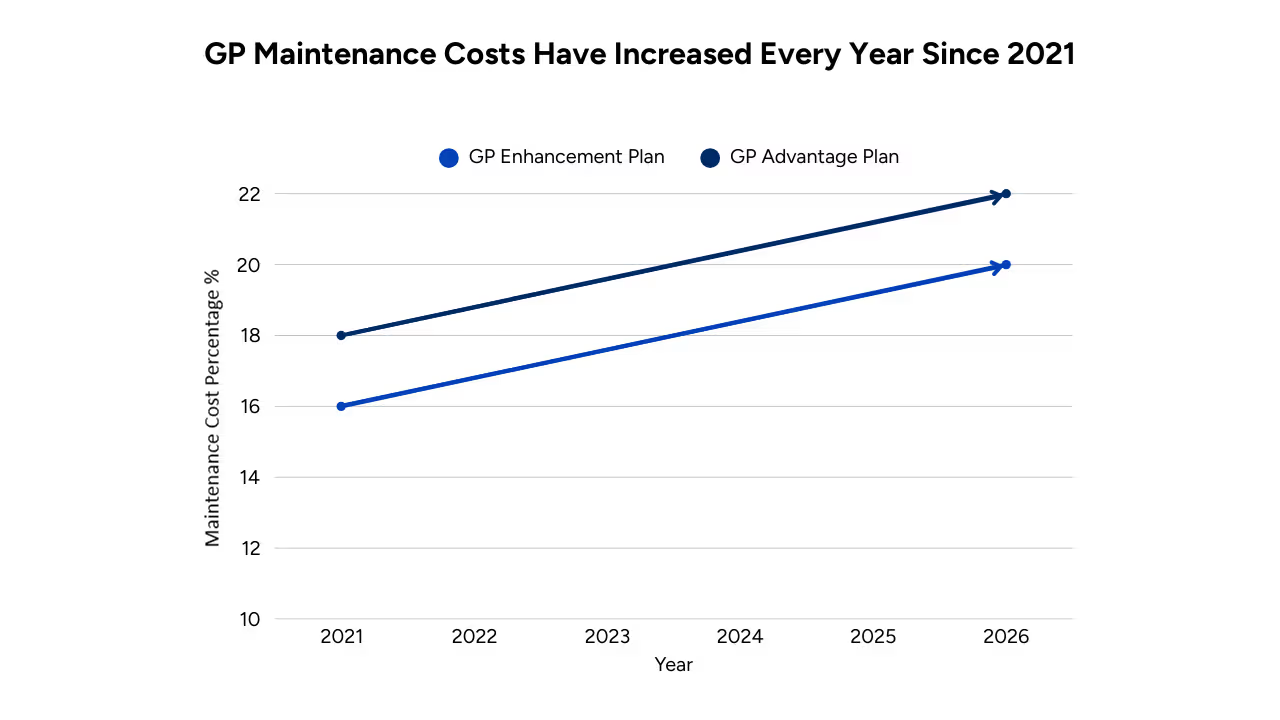
These are not one-time adjustments. They reflect a consistent 1% year-over-year increase. The practical effect is clear: organizations are paying more each year to maintain a system that is approaching end-of-life.
From a budgeting perspective, this shifts the cost curve upward while the product lifecycle moves downward. As 2029 approaches and mainstream support ends, customers will continue paying elevated maintenance percentages for diminishing long-term value. This dynamic directly contributes to the cost of staying on Dynamics GP, as companies absorb rising recurring costs while simultaneously planning for migration.
For finance leaders, the question becomes strategic: How long should you continue increasing annual maintenance spend on a platform with a fixed sunset timeline?
The total cost of ownership of Dynamics GP
Understanding total cost of ownership (TCO) is essential when evaluating the economic impact of Dynamics GP. Total cost of ownership goes beyond the original software purchase price. It includes every direct and indirect expense associated with acquiring, operating, maintaining, upgrading, and eventually replacing a system over its full lifecycle. For finance and IT leaders, TCO provides a more accurate view of long-term financial exposure than looking at annual maintenance or licensing costs alone.
When organizations assess the full TCO of Dynamics GP, they often find that on-premises ERP systems carry compounding operational costs. As support deadlines approach and maintenance rates rise, recurring expenses continue while long-term product value declines. When compared with modern cloud ERP systems such as Dynamics 365 Business Central, the total cost of ownership is often significantly lower over time, even when factoring in the upfront investment required to migrate.
Key Dynamics GP TCO considerations
- Annual maintenance plans: Customers must maintain an Enhancement or Advantage Plan to remain supported, and these recurring fees increase over time. These payments continue even as the product approaches end-of-life.
- Server infrastructure: Dynamics GP requires physical servers or hosted environments that must be maintained, monitored, and eventually replaced. Cloud ERP solutions eliminate the need for this hardware investment and related overhead.
- Software licensing for infrastructure: Running GP requires additional software such as database and server operating system licenses. Cloud systems bundle infrastructure management into the subscription model.
- IT labor and support: Internal IT teams or external partners must manage updates, patches, performance tuning, backups, and security. Cloud ERP shifts much of this operational burden to the provider.
- Upgrade projects: Periodic version upgrades require planning, testing, consulting resources, and potential downtime. Cloud systems provide streamlined updates that are delivered automatically.
- Operational inefficiencies: Manual processes, limited automation, and weaker integration with modern collaboration tools can increase administrative workload. Cloud ERP platforms offer built-in automation and native integration with Microsoft 365 and Power Platform.
- End-of-life replacement costs: As Dynamics GP reaches its sunset timeline, organizations must eventually budget for migration and system replacement. Planning earlier often allows for a smoother transition and more predictable investment.
When evaluated holistically, these factors demonstrate how the cost of staying on Dynamics GP extends far beyond annual maintenance fees. Over time, cloud ERP platforms such as Business Central often deliver a more predictable and sustainable financial model.
To learn more, read our blog on Total Cost of Ownership of Dynamics GP vs. Cloud Solutions.

Opportunity costs of delaying Dynamics GP migration
The most overlooked part of the economic impact of Dynamics GP is opportunity cost. Microsoft has positioned Dynamics 365 Business Central as the successor to Dynamics GP and its primary cloud ERP platform for small and mid-sized businesses. As Microsoft’s investment, product innovation, and AI capabilities continue to focus on Business Central, remaining on GP means operating on a platform that is no longer the strategic direction of Microsoft’s ERP roadmap.
Even if maintenance fees and infrastructure expenses remained flat, which they are not, delaying migration still carries financial consequences. Every year an organization stays on a legacy ERP platform is another year without automation, embedded AI, and modern integrations that reduce labor and friction. The financial impact of delaying Dynamics GP migration is not only about rising costs. It is also about delayed gains.
Delayed automation and workflow efficiency
Modern cloud ERP platforms such as Microsoft Dynamics 365 Business Central include built-in workflow automation that reduces manual processing across finance and operations. These tools allow approvals, notifications, and document flows to move automatically through predefined business rules. When organizations remain on GP, these efficiencies are either unavailable or require custom development and third-party tools.
Cloud ERP platforms support automation through:
- Built-in approval workflows across purchasing, sales, and finance
- Integration with Microsoft Power Automate for cross-system process automation
- Automated document routing and notifications
- Embedded AI-assisted data entry and validation
- Reduced dependency on manual spreadsheets and email chains
Staying on Dynamics GP delays these automation gains. Over time, that delay contributes directly to the economic impact of Dynamics GP by maintaining higher labor costs and slower process cycles.
Missed AI and Copilot-driven productivity gains
One of the most impactful components of the economic impact of Dynamics GP is the absence of embedded artificial intelligence. Modern ERP platforms such as Dynamics 365 Business Central include Copilot features and AI agents that automate routine tasks, improve data accuracy, and accelerate decision-making. Dynamics GP does not provide native AI capabilities, which means organizations continue relying on manual processes that cloud ERP systems now streamline.
Business Central supports AI-powered sales order automation, automated invoice matching and payables processing, AI-assisted bank reconciliation, and natural language forecasting and reporting. These tools reduce manual effort while improving speed and consistency across finance and operations teams. You can learn more about how these tools function in our blog on AI agents in Business Central.
The financial impact of AI adoption is not theoretical. According to Harvard Business Review (2021) and McKinsey Global Institute (2023), organizations implementing AI tools report:
0 %
increase in productivity
0 %
increase in quality
0 %
decrease in costs
When companies remain on Dynamics GP, they delay access to these gains. Over time, that delay contributes directly to the economic impact of Dynamics GP by increasing manual workload, slowing financial processes, and limiting operational efficiency.
Integration gap with Microsoft 365 and Power Platform
Another forward-looking component of the cost of staying on Dynamics GP is ecosystem integration. Modern ERP systems are designed to operate as part of a connected digital platform, not as standalone accounting software. Dynamics 365 Business Central integrates natively with Microsoft 365 and the Power Platform, allowing data to flow seamlessly between finance, operations, and collaboration tools. In contrast, Dynamics GP integrations are more limited and often require customization or third-party solutions to achieve similar functionality.
When ERP systems connect directly to productivity and analytics platforms, teams move faster and make decisions with better information. Real-time collaboration, embedded reporting, and automated workflows reduce friction across departments. Delaying migration extends the integration gap and compounds the opportunity cost, especially as competitors adopt cloud-native ERP systems built for connected work.
Business Central provides native integration with:
- Microsoft Teams for collaboration tied directly to ERP records
- Outlook for embedded ERP data within email workflows
- Excel for real-time financial analysis without manual exports
- Power BI for interactive dashboards and executive reporting
- Power Platform for low-code automation and custom workflows
To learn more, read our Business Central integration guide.
Dynamics GP migration bottleneck problem
Even if you decide to wait, the market may not let you. One of the most overlooked factors in the cost of staying on Dynamics GP is migration capacity. Many organizations assume they can wait until 2028 or 2029 to begin planning. On paper, that sounds reasonable. In reality, the constraint is not just Microsoft’s end-of-support date. The constraint is qualified partner capacity.
According to Microsoft, the U.S. market still has an estimated 15,000 companies running Dynamics GP. However, there are only about 40 qualified partners with deep experience executing GP to Business Central migrations at scale. A realistic throughput for a structured ERP migration is approximately two migrations per partner per month. That equates to roughly 1,000 companies per year across the entire partner ecosystem.
At that pace, it would take 15+ years to migrate every GP customer, even though mainstream support ends in 2029. The math creates a queue. And as deadlines approach, queues create pressure.
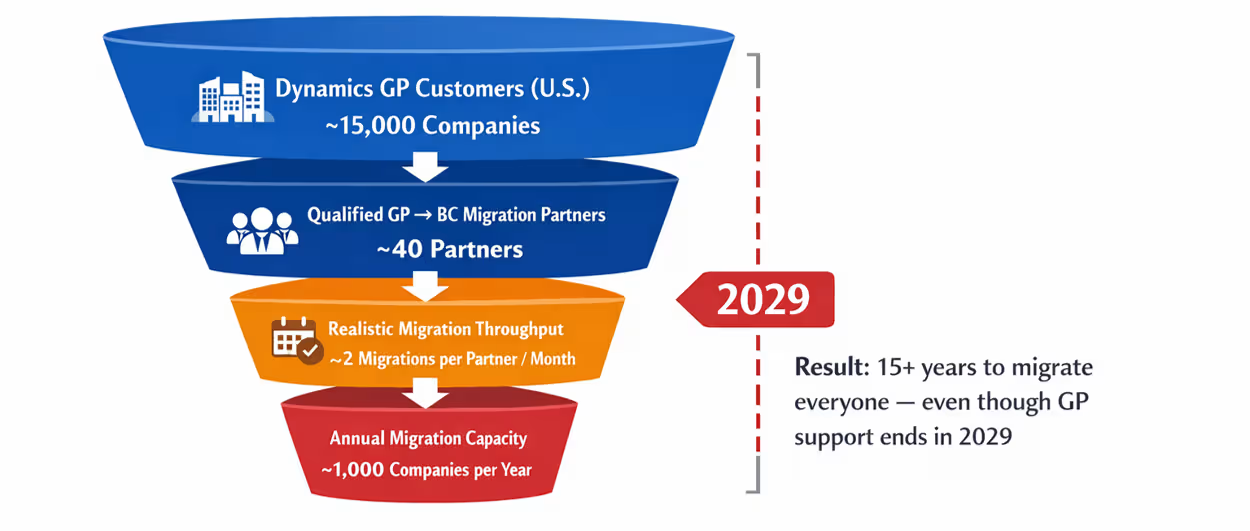
This mismatch between demand and capacity is central to the economic impact of Dynamics GP. If a large percentage of companies wait until 2027 or 2028 to start planning, partner availability will tighten quickly. Complex or highly customized GP environments will be especially affected, as they require more time and specialized expertise.
When migration demand spikes late in the lifecycle, two predictable outcomes occur. First, pricing pressure increases because experienced consultants become scarce. Second, project timelines expand as firms book months in advance. The market is not built for everyone to migrate at the same time.
Many teams plan to migrate closer to the deadline. However, the capacity math suggests that is a risky bet. Early migration is not only a technology decision, it is a risk mitigation strategy that reduces exposure to pricing volatility, scheduling delays, and compressed project timelines.
Economic impact of migrating off Dynamics GP
Any discussion of the economic impact of Dynamics GP should include the financial results organizations report after modernizing their ERP environment. A structured Dynamics GP to Business Central migration is not only a risk mitigation strategy tied to support deadlines. It is also a performance decision that can influence productivity, cost structure, and operational efficiency.
According to The Total Economic Impact™ of Microsoft Dynamics 365 Business Central, a study conducted by Forrester Consulting (October 2023) and commissioned by Microsoft, organizations moving to Business Central experienced significant economic outcomes. For a composite organization modeled in the study, Forrester reported:
0 %
ROI over 3 years
0 %
productivity improvement
$ 0
in annual savings
It is important to clarify that Total Economic Impact (TEI) studies are based on composite organizations constructed from customer interviews. The results are modeled and illustrative rather than guaranteed outcomes. However, they provide directional insight into the scale of potential financial impact.
If migration leads to measurable productivity improvements and cost savings, then delaying migration postpones those benefits. Each year an organization remains on Dynamics GP extends the timeline for capturing ROI. Over multiple years, that delay becomes a tangible contributor to the economic impact of Dynamics GP.

Dynamics GP to Business Central migration workshop
If you are evaluating the economic impact of Dynamics GP, this Dynamics GP to Business Central migration workshop provides a clear, practical view of what a migration really involves. The session compares GP and Business Central, outlines what the transition looks like, and explains how organizations are using AI in Business Central today.
Financial comparison: Migrate now vs migrate later
Timing directly influences the economic impact of Dynamics GP. For most organizations, the decision is not whether to migrate, but when. Evaluating migration as a capital allocation decision rather than a technical project clarifies the financial tradeoffs.
The table below summarizes the financial impact comparison between staying on Dynamics GP and migrating to Business Central.
From a financial standpoint, delaying migration does not preserve capital. It reallocates it toward rising maintenance, infrastructure overhead, and opportunity cost. At the same time, it postpones measurable efficiency gains and potential ROI.
Organizations that migrate earlier often stabilize costs sooner, secure stronger incentive positions, and begin capturing productivity improvements earlier in the lifecycle. When evaluated through the lens of capital planning, the economic impact of Dynamics GP becomes a timing issue as much as a technology issue.
Example: The cost of waiting
To bring these factors together, consider a 25-user Dynamics GP organization evaluating whether to migrate now or delay three years.
The migration project cost is assumed to be the same in both scenarios. The only variable is timing.
As shown in the summary below, delaying three years can create approximately $175,000 in compounding financial impact, driven by four forces:
- Rising recurring costs: Continued GP maintenance and infrastructure spending
- Shrinking migration incentives: Reduced Microsoft transition discounts
- Migration pricing pressure: Increased competition for limited partner capacity
- Delayed productivity gains: Postponed automation, AI, and workflow efficiency
Individually, each factor may appear manageable. Collectively, they compound.
The cost of waiting is not a single line item. It is the accumulation of recurring spend, lost incentives, tighter capacity, and deferred operational improvements.
For many organizations, the decision is not whether to migrate from Dynamics GP. It is whether to absorb these compounding costs while waiting.

Frequently asked questions
When does Dynamics GP support end?
Microsoft Dynamics GP product support ends on December 31, 2029. After that date, Microsoft will no longer provide product enhancements, regulatory or tax updates, service packs, or technical support. Security updates continue until April 30, 2031, which is the official end-of-life date and the final point in the Dynamics GP support timeline.
Can we continue using Dynamics GP after 2029?
You may be able to keep running Dynamics GP after December 31, 2029, but it will be unsupported. Microsoft ends product enhancements, regulatory and tax updates, service packs, and technical support at that milestone. Security updates only continue through April 30, 2031, increasing risk for compliance, cybersecurity, and long-term operational stability.
Why not wait until 2028 or 2029 to migrate?
Waiting until 2028 or 2029 increases scheduling and cost risk because migration capacity is limited. As more organizations move closer to the same deadline, qualified partner availability tightens and project timelines expand. This creates a queue that can push migrations past the 2029 support cutoff, especially for complex or highly customized GP environments.
Are Microsoft licensing incentives for GP to Business Central declining?
Yes, Microsoft’s GP-to-Business Central incentives have declined over time. Discounts were approximately 60% in 2021, later reduced to 40%, and are now around 30% under Bridge to the Cloud 3. While future changes are not guaranteed, the documented trend shows incentives decreasing, which raises the net cost of migrating later.
Why does staying on Dynamics GP become more expensive over time?
Staying on Dynamics GP becomes more expensive because annual service plan costs rise and on-premises environments require ongoing infrastructure and IT support. Organizations also face periodic upgrade projects, security management, and integration work. As product support deadlines approach, these costs continue while long-term platform value declines, increasing the economic impact of Dynamics GP.
What is the economic impact of Dynamics GP if we delay migration?
Delaying migration increases total cost and risk over time. Organizations face rising maintenance and infrastructure costs, shrinking licensing incentives, and limited migration partner availability. They also delay automation, Microsoft 365 integration, and AI productivity gains available in cloud ERP platforms. The combined effect is higher operating cost and deferred ROI, which compounds annually.
Strategic recommendation: Why earlier migration reduces risk and cost
Dynamics GP has clearly published deadlines, with the most significant financial milestone being the end of product support in December 2029. At the same time, Microsoft migration incentives have trended downward, GP service plan rates have trended upward, and partner migration capacity remains limited. These factors create measurable timing risk.
Waiting does not reduce cost. It compounds it. Each year of delay increases maintenance spend, reduces available incentives, tightens partner availability, and postpones automation, Microsoft 365 integration, and AI-driven productivity improvements. Evaluated strategically, the economic impact of Dynamics GP is not only about what you pay to stay, but what you defer by waiting. Rand Group helps Dynamics GP customers assess their current environment, model the financial impact, and execute structured migrations to Dynamics 365 Business Central.
Contact us to learn more about evaluating your Dynamics GP environment and building a structured migration plan.