Dynamics 365
 Power Platform
 Dynamics
 Cloud & Productivity
What is Microsoft Dynamics 365 Finance and Supply Chain Management (D365 F&SCM)?

Running a mid-sized or large business is complicated. You have finance teams closing the books. Operations teams managing inventory. Supply chain teams keeping production moving. When these functions run on separate systems, gaps appear — in data, visibility, and decision-making.
Microsoft Dynamics 365 Finance and Supply Chain Management (D365 F&SCM) solves that problem. It is an enterprise resource planning (ERP) solution from Microsoft. It unifies finance, operations, and supply chain under one intelligent platform. In this blog, you will learn what D365 F&SCM is, what it includes, who it is built for, how it is priced, and what implementation looks like.
What is Dynamics 365 Finance and Supply Chain Management?
Dynamics 365 Finance and Supply Chain Management (D365 F&SCM) is a cloud-based enterprise resource planning (ERP) solution from Microsoft designed for mid-sized to large organizations. It unifies financial management and supply chain operations in a single platform, helping businesses manage accounting, procurement, inventory, manufacturing, warehousing, and logistics with real-time visibility and control.
Dynamics 365 Finance and Supply Chain Management was previously known as Dynamics 365 Finance & Operations (F&O). Microsoft later separated it into two applications — Dynamics 365 Finance and Dynamics 365 Supply Chain Management. Together, they are known as D365 F&SCM.
Here is what each application does:
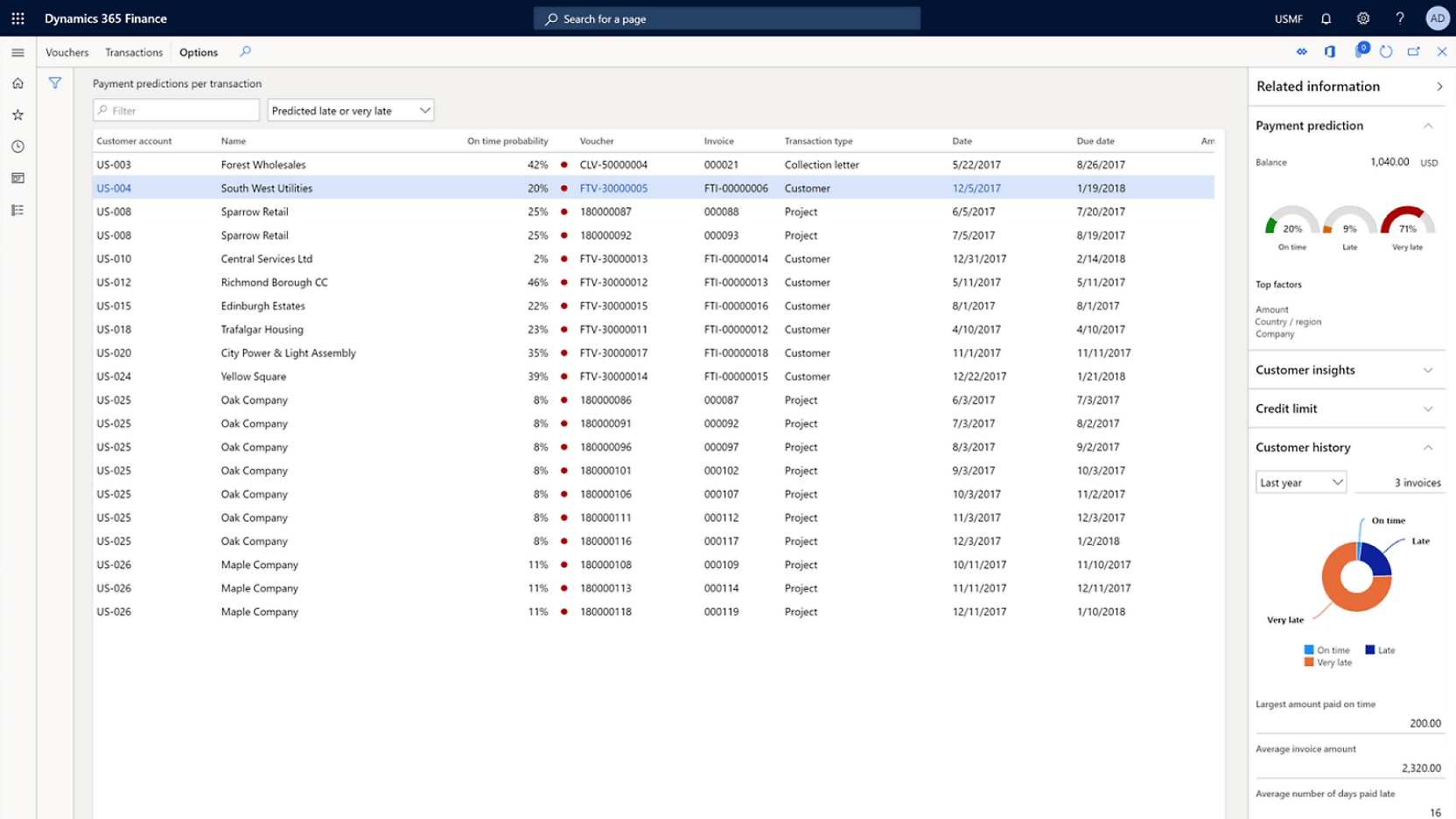
- Dynamics 365 Finance handles the financial side of your business. It manages general ledger, accounts payable and receivable, budgeting, fixed assets, cash management, and project accounting. It also helps with global compliance. It uses AI to forecast cash flow, predict customer payments, and automate key financial processes.
- Dynamics 365 Supply Chain Management handles the operational side. It covers procurement, inventory, production, warehousing, transportation, and asset management. It uses AI and machine learning to build smarter, more resilient supply chains.
Both applications can be deployed on their own. However, most organizations deploy them together. When Finance and Supply Chain Management share data, the entire business benefits.
Key capabilities and features of Dynamics 365 Finance & Supply Chain Management
Dynamics 365 Finance & Supply Chain Management offers a wide range of capabilities across both applications. It is not a one-size-fits-all solution. Instead, it brings together two purpose-built applications — Dynamics 365 Finance and Dynamics 365 Supply Chain Management — each with its own deep set of capabilities. Here is a breakdown of what each one covers.
Dynamics 365 Finance capabilities
- General ledger and financial close: Every transaction across your organization gets tracked in one place. Automated reconciliation and self-serve analytics help finance teams close the books faster and with fewer errors.
- Accounts payable and accounts receivable: Both sides of your cash flow are managed in one system. Accounts payable automation speeds up vendor payments using AI-powered invoice capture, while predictive tools flag overdue customer accounts and forecast when payments will arrive.
- Cash management and budgeting: Real-time visibility into your cash position combines with scenario-based budgeting tools. Together, they help your team plan ahead, adjust quickly, and make confident financial decisions.
- Fixed assets and cost accounting. Physical assets are tracked across their full lifecycle, with depreciation running automatically. Cost accounting gives you a detailed view of where money is being spent — down to the project level. For organizations that need tighter financial controls, expense management and the audit workbench work together in D365 Finance to streamline approvals and simplify auditing.
- Global compliance and tax management: Built-in tools support operations in more than 57 countries and 67 languages. The system includes functionality to help manage tax rules, regulatory requirements, and e-invoicing standards.
- Business performance analytics and reporting: Financial and operational data comes together in one unified view. Teams get self-serve dashboards and reports — without waiting on IT. To learn more about what reporting looks like in practice, read our blog, The ultimate guide to reporting in Dynamics 365 Finance and Operations.
Dynamics 365 Supply Chain Management capabilities
- Procurement and inventory management: The entire purchase-to-pay process is automated from requisition to payment. Real-time inventory tracking across all locations means you always know what you have, where it is, and when to reorder.
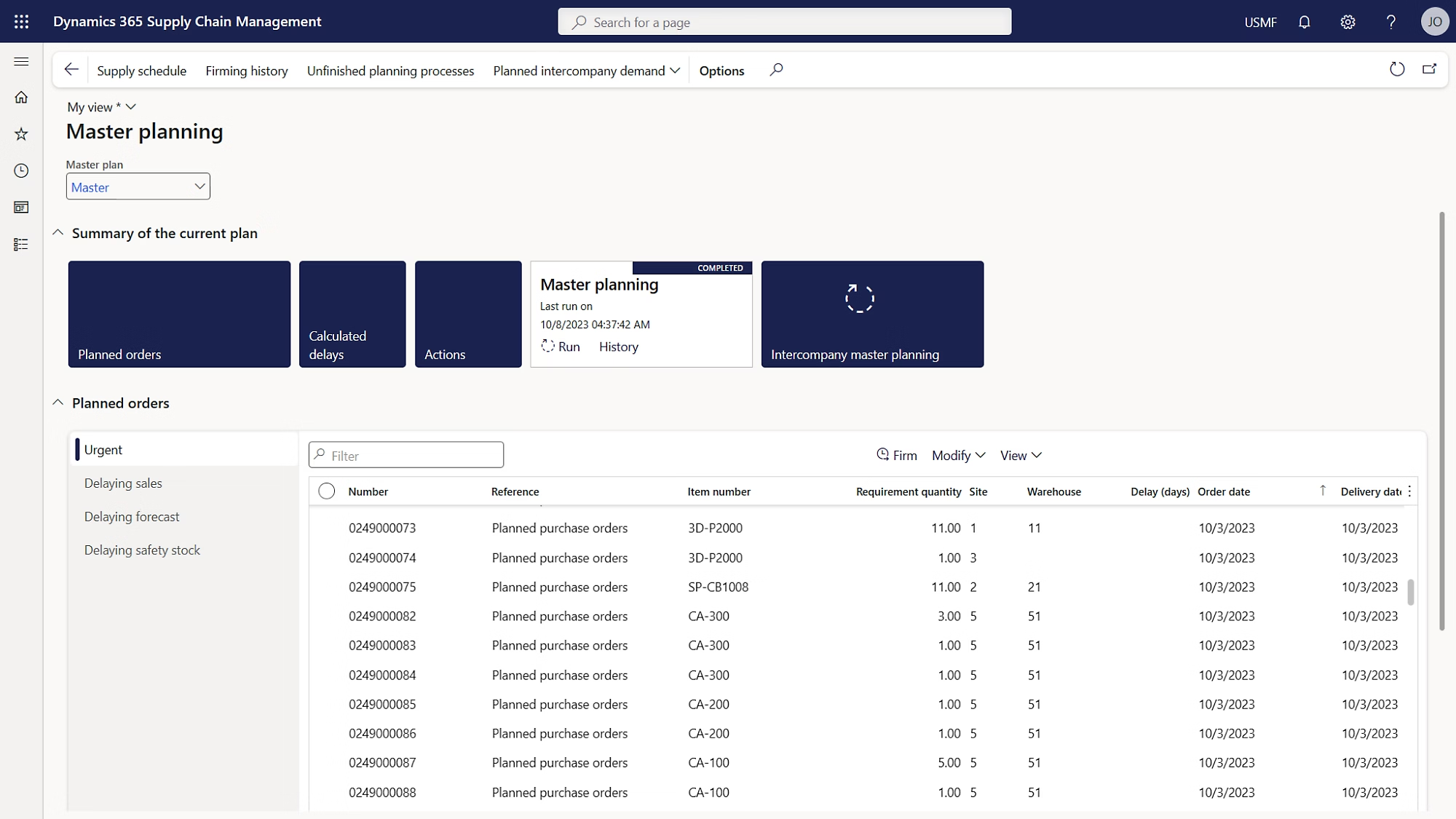
- Demand forecasting and master planning: AI predicts what you will need before shortages occur. Planning runs continuously align supply with demand to reduce disruptions and avoid excess stock.
- Production control and shop floor management: Production orders, scheduling, and work-in-progress are managed in one place. IoT sensors and real-time data give visibility into exactly what is happening on the shop floor.
- Warehouse and transportation management: Workers are guided through picking, packing, and put-away tasks using modern warehouse management tools on mobile devices. Shipments across multiple carriers and modes are planned and tracked in one system, with route optimization reducing costs.
- Asset management and predictive maintenance: Equipment health is monitored continuously, and maintenance is scheduled before breakdowns happen. This reduces unplanned downtime and extends the life of your assets.
- Product information and order management: All product data — specs, pricing, and descriptions — lives in one centralized location. The full order-to-cash process, from quotation to delivery, is managed end to end with real-time inventory data supporting accurate customer promises.
Additionally, Microsoft Dynamics 365 Copilot is built into both applications. It summarizes financial records, flags supply chain risks, automates invoice workflows, and drafts supplier communications — all using natural language. To dive deeper into how AI is transforming D365 F&SCM, read our blog on AI agents in Microsoft Dynamics 365 F&SCM.

White paper
Get the full picture on D365 F&SCM pricing
From subscription tiers and user types to attach licensing savings and cloud benefits, our D365 Finance & Operations pricing and licensing guide covers everything you need to understand before making a decision.
Who is Dynamics 365 Finance and Supply Chain Management for?
D365 F&SCM is built for mid-sized to large organizations. It is designed for companies with complex, high-volume operations. This includes businesses managing multiple legal entities, global operations, or large-scale manufacturing and logistics networks.
Industries that benefit most include:
- Manufacturing — for discrete and process manufacturers managing complex production environments
- Distribution and logistics — for wholesale distributors managing large inventory and fulfillment networks
- Oil and gas — for oilfield services and drilling companies with complex asset and cost requirements
- Construction and real estate — for project-based organizations needing project accounting and procurement control
- Food and beverage — for manufacturers and distributors managing compliance, production, and multi-location operations
- Healthcare and life sciences — for organizations requiring strict regulatory compliance and traceability
The key qualifier is complexity and scale. If your organization manages complex financial structures, global supply chains, or high-volume production — D365 F&SCM is built for you. If you are a smaller business with simpler needs, Dynamics 365 Business Central is likely a better fit.
Real-world success: How Conquest Completion Services transformed their operations with F&SCM
Organizations that move from disconnected systems to a unified ERP like Dynamics 365 Finance & Operations often see significant improvements in efficiency, visibility, and financial performance.
For example, Conquest Completion Services, an oilfield services company, replaced a combination of QuickBooks, Excel, and paper-based processes with Dynamics 365 Finance & Operations and Dynamics 365 Field Service. This shift enabled the organization to centralize financial and operational data, automate key workflows, and gain near real-time visibility into performance.
As processes became more streamlined, Conquest significantly improved operational efficiency and cash flow. The company reduced invoicing timelines, accelerated purchase order approvals, and gained accurate, real-time insight into inventory and cost structures. With increased automation and system integration, Conquest was also able to reduce reliance on manual processes and optimize staffing levels, while improving key financial metrics such as days sales outstanding (DSO).
This transformation reflects the broader impact of ERP modernization—moving organizations away from fragmented systems and toward connected, data-driven operations that support faster decision-making and scalable growth. Read the full Conquest Completion Services case study
0 %
reduction in A/R and A/P headcount
0 %
faster PO approval process
0
days DSO, down from 15–20 days
Benefits of Dynamics 365 Finance and Supply Chain Management
Every ERP promises to improve your business — but not every ERP delivers on that promise. What sets D365 F&SCM apart is that it is not just a system of record, it is a system of intelligence. Below are the top business value drivers that make D365 F&SCM one of the most capable ERP platforms available today.
- Real-time financial visibility: Finance teams get instant insight into cash position and performance. No more waiting for end-of-month reports.
- AI-powered forecasting: D365 Finance uses AI to predict payment behavior and automate budget proposals. Decisions happen faster and with more confidence.
- Smarter supply chain planning: Machine learning optimizes demand forecasting and inventory levels. Disruptions are reduced. Costs go down.
- Process automation: Routine tasks like invoice capture, purchase orders, and payment runs are automated. Manual effort drops. Errors decrease.
- Global compliance: The platform supports operations in more than 57 countries and 67 languages. Tax and regulatory tools are built in.
- Microsoft Copilot: Copilot helps users work faster across Finance and Supply Chain. It surfaces insights, flags risks, and takes action — all in natural language.
- Scalability: D365 F&SCM grows with your organization as you add entities, enter new markets, or increase volumes.
- Microsoft ecosystem integration. The platform connects natively with Power BI for reporting, Power Automate for workflow automation, and tools like Teams, Outlook, and Excel.

Dynamics 365 Finance and Supply Chain Management pricing
D365 F&SCM uses a per-user, per-month subscription model. Dynamics 365 Finance and Supply Chain Management are each licensed separately. That gives organizations the flexibility to buy only what they need. Here is a high-level overview:
The attach license is important to understand. If you buy one application at full price, you can add the second for just $30 USD/$40.70 CAD per user per month. This makes deploying both applications very cost-effective.
When it comes to minimum licensing requirements, the standard Finance and Supply Chain Management licenses each require a minimum of 20 full user licenses. The Premium tier for both applications has a lower minimum of 10 licenses.
Keep in mind that licensing is only part of the total investment. Implementation, data migration, integrations, training, and support all factor into the overall cost. For a full breakdown, read our D365 Finance and Supply Chain Management pricing guide.
Dynamics 365 F&SCM implementation process and timeline
Implementing D365 F&SCM is one of the most significant technology investments your organization will make. It is not just about installing software. It is about redesigning how your business manages financial data, supply chain operations, and day-to-day processes. Done right, it sets the foundation for long-term efficiency, scalability, and growth. Done poorly, it can result in cost overruns, disrupted operations, and a system that your team struggles to use. Rand Group offers three implementation approaches to match different levels of organizational complexity and internal readiness. Each one follows a structured methodology designed to reduce risk, drive user adoption, and deliver measurable results.
- Rapid Activation is a streamlined, fixed-fee deployment. It focuses on core functionality with limited customization. It follows industry best practices and can get you live in six to eighteen months. It works best for organizations with in-house ERP expertise that want to move quickly.
- Hybrid implementation is a shared-responsibility approach. Rand Group handles core configuration. Your internal team leads testing, training, and deployment. This is a good fit for organizations with some Dynamics 365 experience and strong internal capabilities.
- Full Digital Transformation is the comprehensive option. It covers everything — deep planning, full data migration, system integrations, user acceptance testing, and change management. It is the recommended path for organizations with complex processes or multi-entity structures. Timelines typically range from eight to twenty-four months.
Implementation costs generally range from $250,000 to over $1 million. The final number depends on scope, integrations, and data complexity. To learn more, read our D365 Finance & Supply Chain Management implementation guide.
Is Dynamics 365 Finance & Supply Chain Management right for your organization?
Not every ERP solution is built for every business. D365 F&SCM is a powerful platform, but it is designed with a specific type of organization in mind. Before committing to any ERP investment, it is worth taking a step back and asking whether the solution actually fits your size, complexity, and long-term goals.
D365 F&SCM is likely a strong fit if your organization:
If several of the following apply to your business, D365 F&SCM is worth serious consideration. These are the characteristics that the platform is specifically designed to support. Organizations that match this profile tend to see the strongest return on their ERP investment.
- Manages multiple legal entities or operates across multiple countries
- Has complex financial reporting requirements
- Runs manufacturing, production, or warehouse operations at scale
- Manages a global or multi-tier supply chain
- Is on a legacy platform like Dynamics AX, or an aging on-premises ERP
- Has 200 or more employees with significant operational complexity
D365 F&SCM may not be the right fit if your organization:
On the other hand, D365 F&SCM may be more than your organization needs right now. It is a robust, enterprise-grade solution — and that comes with a corresponding level of investment in time, budget, and resources. If your business is earlier in its growth journey or has relatively straightforward operations, a different Microsoft ERP may serve you better.
- Is a small to mid-sized business with straightforward needs
- Does not require multi-entity or multi-country support
- Needs a faster, lower-cost ERP path
In that case, Microsoft Dynamics 365 Business Central is worth exploring. It is Microsoft’s ERP for smaller organizations. It is more affordable and faster to implement. For a full comparison, read the difference between D365 F&SCM and Business Central.

Ready to see what D365 F&SCM can do for your business?
Whether you are evaluating ERP options for the first time or planning a migration from a legacy system, our team is here to help. Speak with a Rand Group D365 F&SCM specialist to get your questions answered, request a demo, or get a project estimate.
Why partner with Rand Group for your D365 F&SCM implementation?
Selecting the right ERP is only half the battle. The partner you choose to implement it is equally important. A poorly executed implementation — even with the right software — can lead to cost overruns, missed deadlines, low user adoption, and a system that does not reflect how your business actually operates. On the other hand, the right partner brings structure, experience, and accountability to every phase of the project. Rand Group is a Microsoft-certified partner with a long track record of successful Dynamics 365 Finance & Supply Chain Management implementations. Our team combines deep technical knowledge with real-world business experience — so your implementation is built around your processes, not the other way around. Here is what you can expect when you partner with Rand Group:
- Deep Microsoft expertise: Rand Group’s team includes CPAs and industry professionals. They understand both the technical and business sides of ERP. That combination leads to implementations that reflect how your business actually works.
- Industry-specific experience: Rand Group has delivered D365 F&SCM implementations across many different industries. Deep industry knowledge means fewer surprises.
- Proven implementation methodology: Whether you choose Rapid Activation, Hybrid, or Digital Transformation, Rand Group follows a structured process that reduces risk and drives adoption.
- Training and ongoing support: Getting your team up to speed is a critical part of any ERP project. Rand Group provides Dynamics 365 F&SCM training to ensure users are confident from day one. Beyond go-live, Rand Group provides ongoing D365 F&SCM support — from troubleshooting and customizations to integrations and new feature enablement.
- 90% client retention rate: Long-term partnerships are the standard at Rand Group — not the exception.
Frequently asked questions (FAQ)
What is the difference between D365 F&SCM and Dynamics 365 F&O?
They refer to the same solution. Dynamics 365 Finance & Operations (F&O) was the original name. Microsoft later split it into two applications — Dynamics 365 Finance and Dynamics 365 Supply Chain Management. Together, they are called D365 F&SCM. You will still see F&O used widely, but both terms describe the same platform.
Can we implement just Dynamics 365 Finance or just Dynamics 365 Supply Chain Management, or do we need both?
You can implement either one on its own. That said, deploying both together delivers the most value. Data flows seamlessly between the two applications, and the attach license pricing makes it very cost-effective. For a full breakdown of licensing options, read our D365 Finance & Supply Chain Management pricing guide.
How is D365 Finance & Supply Chain Management different from Dynamics 365 Business Central?
Both are Microsoft ERP solutions. But they serve different markets. Business Central is designed for smaller businesses with simpler needs. D365 F&SCM is built for medium to large enterprises with complex financial structures, global operations, and advanced manufacturing or supply chain requirements. If you have outgrown Business Central or have complex needs from the start, D365 F&SCM is the stronger fit. For a full comparison, read the difference between D365 F&SCM and Business Central.
How long does a D365 F&SCM implementation typically take?
It depends on the approach and scope. Rapid Activation can take six to eighteen months. A Hybrid implementation typically falls in the six to twelve month range. A full Digital Transformation can take eight to twenty-four months. To learn more, read our D365 Finance & Supply Chain Management implementation guide.
What does licensing for D365 Finance & Supply Chain Management look like?
Both applications start at $210 USD/$284.90 CAD per user per month. A Premium tier is available at $300/$407.00 CAD per user per month. If you purchase both applications, the second is available as an attach license for just $30 USD/$40.70 CAD per user per month. For a full breakdown, read our D365 Finance & Supply Chain Management pricing guide.
Next steps
Dynamics 365 Finance & Supply Chain Management is one of the most capable ERP platforms available for enterprise organizations today. It brings together financial management, supply chain operations, manufacturing, and AI-powered intelligence in one connected cloud system.
If you are evaluating ERP options, planning a migration from Dynamics AX or GP, or just trying to understand whether D365 F&SCM is right for your organization — the best next step is to talk to an expert. Contact Rand Group today to speak with a D365 F&SCM specialist, request a demo, or get a project estimate.