Dynamics 365
 Power Platform
 Dynamics
 Cloud & Productivity
Dynamics 365 Finance & Operations for multi-entity and global organizations

For companies evaluating Dynamics 365 Finance & Operations for multi-entity organizations, the challenge is rarely just adding another company. As organizations add subsidiaries, acquisitions, and international operations, disconnected systems, inconsistent processes, and manual intercompany work can make it harder to coordinate operations and get a reliable view of performance.
Dynamics 365 Finance & Operations provides a connected ERP foundation for managing that growing complexity across finance and operations. For organizations evaluating different approaches to multi-company finance, explore how leading multi-entity accounting software and ERP systems support growing financial complexity.
At a glance
Dynamics 365 Finance & Operations supports organizations that operate multiple legal entities, business units, currencies, and countries. Dynamics 365 Finance can manage intercompany accounting, centralized payments, financial consolidation, currency translation, and country-specific requirements, while Dynamics 365 Supply Chain Management can extend multi-entity processes into purchasing, sales, inventory, and fulfillment. Successful global ERP design depends on deciding which processes should follow a common corporate standard and which must remain local.
What is Dynamics 365 Finance & Operations for multi-entity organizations?
Dynamics 365 Finance & Operations is a cloud ERP platform built around two core applications: Dynamics 365 Finance and Dynamics 365 Supply Chain Management. Organizations can use the applications individually or together based on their financial and operational requirements.
For multi-entity organizations, Dynamics 365 Finance & Operations provides a shared ERP environment for managing separate legal entities. It also supports consolidated reporting, intercompany activity, multiple currencies, and common financial and operational processes.
A key part of configuring Dynamics 365 Finance & Operations for a multi-entity organization is determining which parts of the business should be established as separate legal entities. A legal entity has its own ledger setup. It can maintain its own accounting and reporting currencies, fiscal calendar, financial settings, and statutory requirements. Departments, cost centers, business lines, and other internal structures may instead be represented through organizational structures or financial dimensions when separate legal accounting is not required.
Creating unnecessary legal entities can add administrative and cross-company complexity. At the same time, a company that needs independent statutory accounting should not be treated simply as a reporting dimension. The ERP structure should reflect how the organization legally operates, transacts, and reports. It should not simply copy the structure of the system being replaced. Learn more about Dynamics 365 Finance & Operations capabilities.
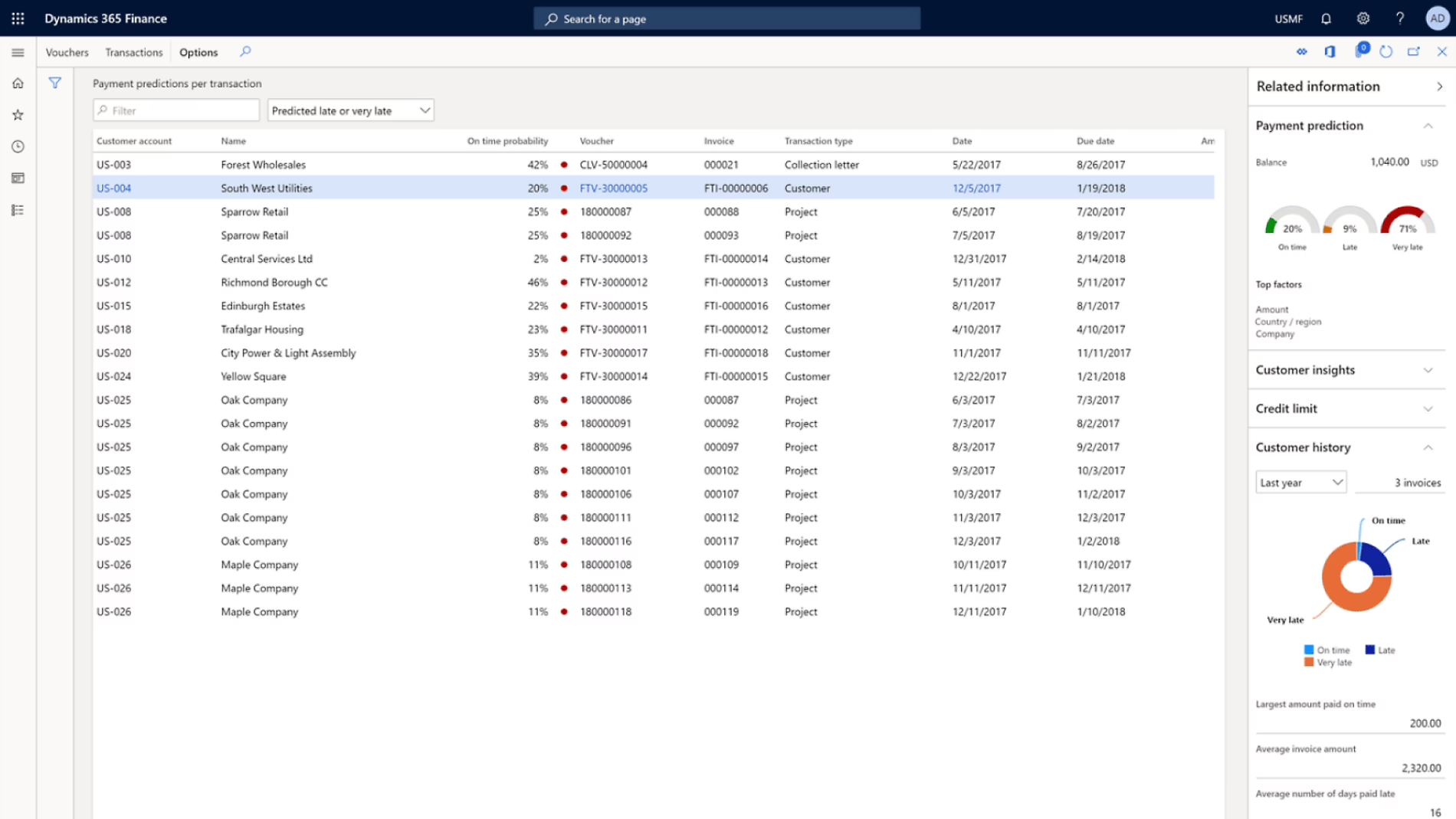
Why multi-entity organizations outgrow disconnected ERP systems
Separate accounting systems and spreadsheets may work when an organization has only a few entities and limited intercompany activity. The difficulty grows as subsidiaries become more connected.
Corporate finance may have to collect trial balances, translate currencies, reconcile intercompany balances, and map different account structures. It may also have to create manual consolidation adjustments before leadership can see group results.
Common warning signs include:
- Consolidation depends heavily on spreadsheet exports and manual adjustments.
- Intercompany receivables and payables regularly fall out of balance.
- Legal entities maintain inconsistent customers, vendors, products, or financial structures.
- Finance spends significant time moving information between subsidiaries and corporate reporting.
- Regional processes have drifted away from corporate policies and controls.
- New acquisitions or international entities take too long to incorporate into group reporting.
The problem is not simply managing more companies. It is maintaining visibility, consistency, and control as financial and operational activity moves between them.
How Dynamics 365 Finance & Operations supports multi-entity and global operations
Dynamics 365 Finance and Dynamics 365 Supply Chain Management address different parts of multi-entity management. Understanding those differences helps organizations avoid treating intercompany accounting, intercompany trade, consolidation, and centralized payments as the same process.
Manage multiple legal entities while maintaining separation
Dynamics 365 Finance allows organizations to establish multiple legal entities and define how they relate to one another.
Corporate teams can establish common financial structures and governance. Individual entities can maintain company-specific requirements such as banking, tax setup, payment processes, and local accounting rules. This creates a balance between group-level control and entity-level independence.
Create consistent financial structures
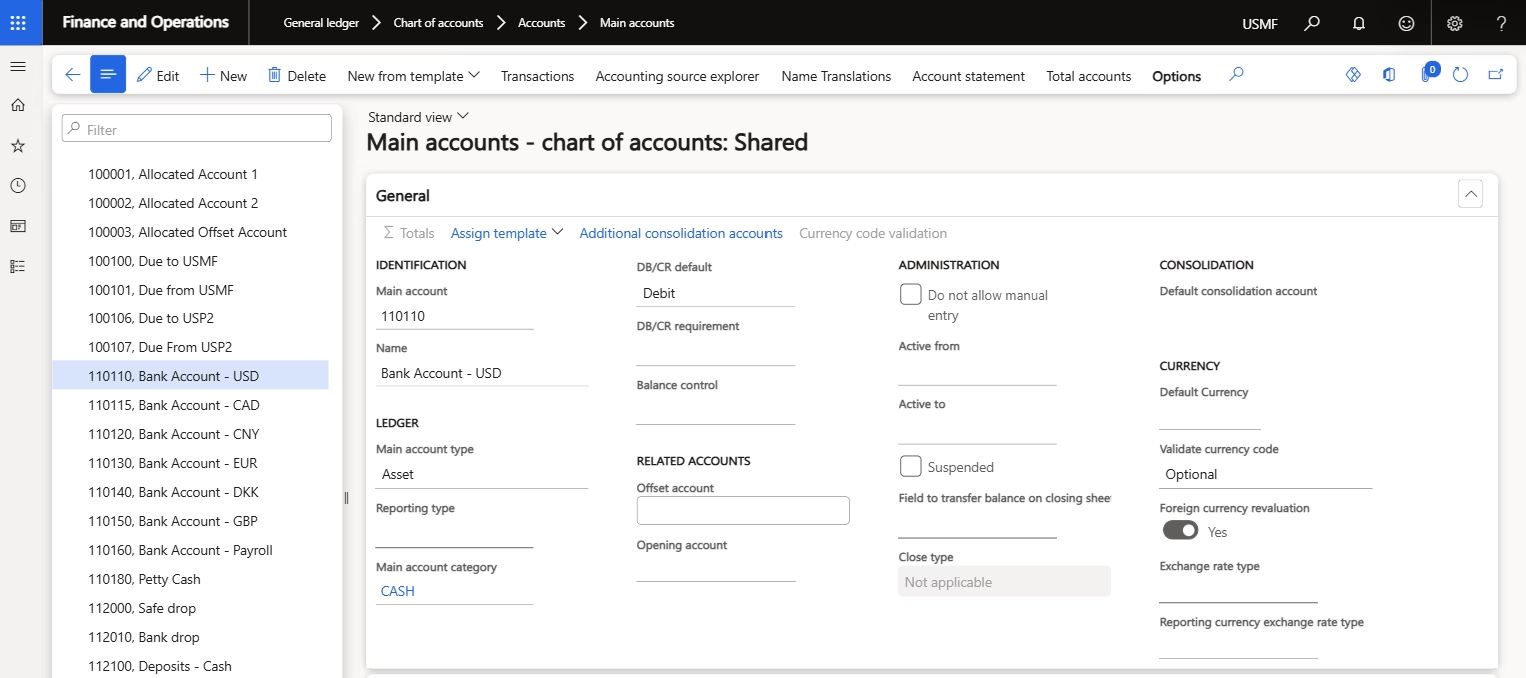
Reliable group reporting starts with financial design. Dynamics 365 Finance supports charts of accounts and financial dimensions that can create common reporting structures across legal entities. Financial dimensions can be used to analyze departments, cost centers, business lines, locations, and other management categories. This can be done without creating additional legal entities.
Organizations may use a common chart of accounts where practical. They may also maintain local account structures and map them into corporate reporting when statutory or operational requirements differ.
Manage intercompany accounting
Intercompany accounting handles financial transactions between related legal entities.
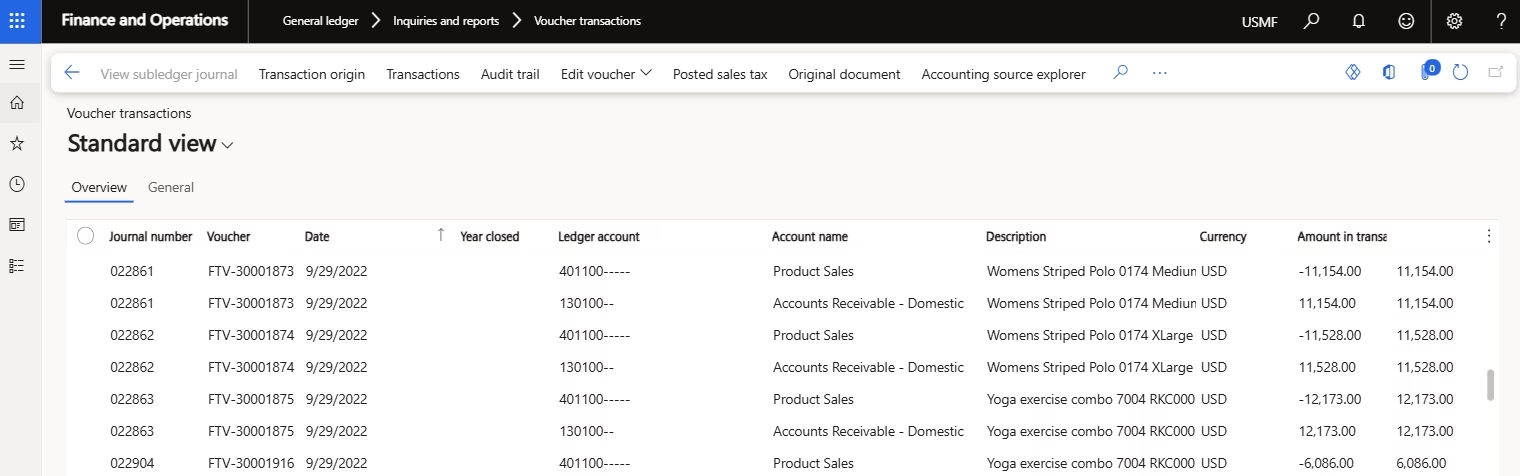
For example, a corporate entity may pay an expense for a subsidiary or allocate a shared service cost to another company. When the intercompany relationship is configured in Dynamics 365 Finance, the transaction can create corresponding accounting entries in both entities. These entries use the appropriate due-to and due-from accounts. This helps reduce duplicate entry and improves traceability between companies.
Intercompany accounting is different from intercompany sales and purchasing. Financial journal activity is handled in Dynamics 365 Finance. Cross-company sales and purchasing processes are supported through Dynamics 365 Supply Chain Management. See practical setup considerations for intercompany accounting in Dynamics 365 Finance.
Connect intercompany sales and supply chain activity
Some multi-entity transactions begin with an operational process rather than a journal entry. A sales company may sell inventory that another legal entity owns and ships. A manufacturing company may supply products to another company’s warehouse.
Dynamics 365 Supply Chain Management can connect related intercompany sales and purchase orders. Activity in one company can then drive the corresponding process in another.
For organizations with supply chains that cross legal entity boundaries, this provides a clearer connection between the physical movement of goods and the resulting financial activity.
Centralize vendor and customer payments
Organizations using shared-service or centralized treasury models may want one legal entity to manage payments for several others.
Dynamics 365 Finance supports centralized vendor and customer payments between participating legal entities. The system can create the corresponding intercompany accounting activity when one entity settles transactions on behalf of another.
This can centralize payment controls while allowing subsidiaries to maintain their own financial records.
Manage currencies and consolidated reporting
Global organizations may transact and report in several currencies.
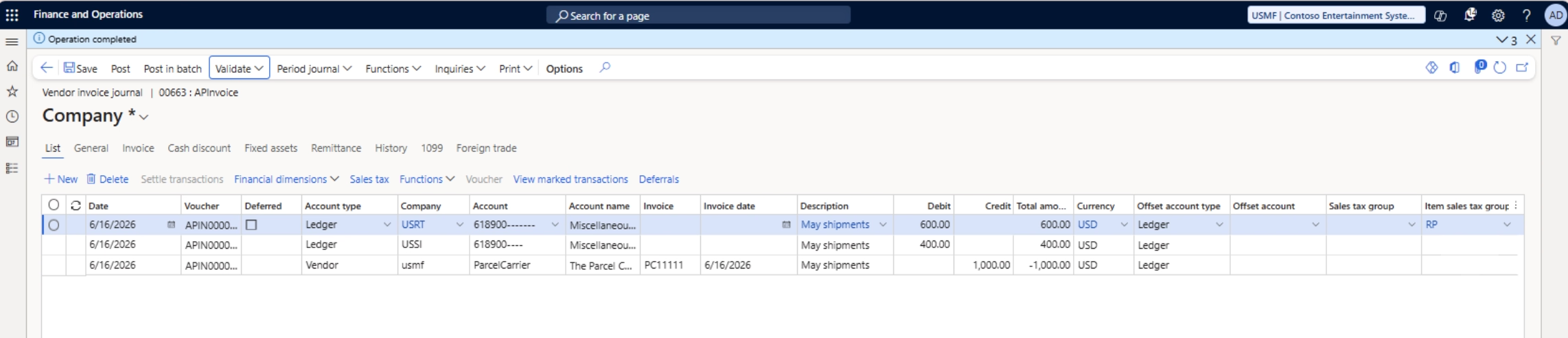
Dynamics 365 Finance supports accounting and reporting currencies, foreign currency transactions, revaluation, and currency translation. It also supports consolidated reporting across legal entities. This includes scenarios with different currencies, account structures, fiscal periods, and intercompany eliminations.
Organizations should design exchange-rate policies, financial structures, and consolidation requirements early. Waiting until the end of an implementation to address consolidation can create unnecessary rework.
Support country-specific requirements
International operations may also introduce different tax, banking, electronic invoicing, statutory reporting, and document requirements.
Dynamics 365 Finance includes globalization and localization capabilities, but functionality varies by country and regulatory requirement. A global implementation should therefore identify country-specific requirements before the corporate template is finalized.
Additional configuration, partner localization, or extensions may be required where standard functionality does not address a local requirement.
How Dynamics 365 Finance & Operations addresses common multi-entity challenges
The following table summarizes how Dynamics 365 Finance and Dynamics 365 Supply Chain Management can address common challenges found in multi-entity organizations.
How Copilot supports multi-entity finance and operations
AI can help finance and operations teams manage some of the workload that comes with operating across multiple legal entities, currencies, suppliers, and business processes. However, it does not replace the underlying multi-entity design, controls, or governance.
Copilot and AI agents are increasingly embedded across Dynamics 365 Finance and Dynamics 365 Supply Chain Management.
For multi-entity organizations, relevant capabilities include:
- Support period-end reconciliation. The Account Reconciliation Agent in Dynamics 365 Finance can help identify, match, and address reconciliation exceptions. Finance teams can review reconciliation status by legal entity and financial area, helping them focus attention on unresolved issues during the close process. Microsoft currently classifies the Account Reconciliation Agent as a production-ready preview. Although Microsoft’s release plan targeted general availability for September 2026, current product documentation still identifies the capability as preview.
- Analyze demand across complex operations. Copilot in Dynamics 365 Supply Chain Management can help planners investigate demand shifts, trends, anomalies, and forecast performance using natural-language insights. This can help global organizations work through large planning datasets and identify issues that could affect inventory or supply across operations.
- Evaluate the impact of supplier changes. The Procurement Agent can help purchasers understand the downstream impact of proposed purchase order changes. For organizations with interconnected supply chains, this can help teams determine whether a supplier change could affect planned supply, production, or customer commitments. Microsoft currently classifies the Procurement Agent and its impact analysis capabilities as production-ready preview.
- Automate supplier follow-up. The Procurement Agent can also assist with repetitive supplier communications and purchase order follow-up. This can reduce manual work for procurement teams managing a large number of suppliers and purchasing activities.
These AI capabilities can help multi-entity organizations identify exceptions faster, analyze complex operational data, and reduce repetitive work. However, their effectiveness still depends on accurate master data, appropriate security, consistent cross-company processes, and human oversight of AI-generated recommendations and actions.


Understand Dynamics 365 Finance & Operations pricing before planning your rollout
Licensing requirements can vary based on the applications, user roles, and functionality your organization needs. Get a clearer view of user types, subscription options, base and attach licensing, and other factors to consider. These considerations can help when planning a multi-entity ERP investment.
What should be standardized globally and managed locally?
A global ERP does not require every legal entity to work exactly the same way. The goal is to standardize processes where consistency improves control and reporting. Local variation can remain where business or regulatory requirements justify it.
A strong global template is not one with no exceptions. It is one where every exception has a clear business, operational, or regulatory reason.
What does a multi-entity process look like in Dynamics 365 Finance & Operations?
Consider a global distributor with a Canadian sales entity and a separate U.S. distribution entity.
A Canadian customer places an order with the sales entity, but the U.S. entity owns and ships the inventory.
The process could look like this:
Customer order → Canadian sales entity → Intercompany order → U.S. distribution entity → Shipment → Intercompany financial activity → Entity reporting → Group consolidation
Dynamics 365 Supply Chain Management can connect the sales and purchasing activity between the entities. Dynamics 365 Finance records the related financial impact and supports group reporting.
The exact configuration depends on inventory ownership, currencies, tax requirements, transfer pricing, and the financial responsibilities of each entity. This is why finance, operations, tax, and technology teams should design cross-company processes together. They should not configure each legal entity independently.
When should a multi-entity organization consider Dynamics 365 Finance & Operations?
Having several companies does not automatically mean an organization needs Dynamics 365 Finance & Operations.
The platform becomes more relevant when an organization:
- Operates several legal entities, subsidiaries, or international companies
- Has frequent or complex intercompany financial transactions
- Needs consolidated reporting across companies, account structures, or currencies
- Wants to centralize finance, treasury, procurement, or other shared services
- Manages supply chain processes across legal entity or country boundaries
- Needs stronger global governance while maintaining legitimate local requirements
The decision should also consider transaction volume, operational complexity, reporting requirements, localization, integrations, security, and future growth.
What should you plan before implementing global ERP software?
The most important multi-entity decisions often happen before configuration starts. Based on what we see in complex ERP projects, organizations should address these areas early:
- Define the legal entity structure. Identify which parts of the business truly need separate statutory accounting, currencies, tax treatment, or operational processes. Avoid automatically recreating the legacy structure.
- Design reporting first. Start with the consolidated and entity-level reports leadership needs. Then build the chart of accounts and financial dimensions around those requirements.
- Map complete intercompany processes. Document who buys, sells, pays, ships, owns inventory, allocates costs, and records revenue. Do this across each major cross-company scenario.
- Separate global standards from local requirements. Identify country-specific tax, banking, statutory reporting, e-invoicing, and accounting requirements. Do this before finalizing the global template.
- Assign master data ownership. Establish responsibility for customers, vendors, products, dimensions, exchange rates, and other shared or company-specific information.
- Test real cross-company scenarios. Include intercompany activity, foreign currencies, consolidated reporting, integrations, security, and a realistic month-end close. Avoid testing each entity only in isolation.
For additional project guidance, review our Dynamics 365 Finance & Operations implementation process.

Plan your multi-entity Dynamics 365 Finance & Operations strategy
Whether you are consolidating ERP systems, adding legal entities, expanding internationally, or redesigning how subsidiaries work together, Rand Group can help. We can help you define the financial, operational, and technical foundation for a scalable Dynamics 365 Finance & Operations environment.
Why work with Rand Group for a multi-entity Dynamics 365 Finance & Operations implementation?
Multi-entity implementations involve more than configuring separate companies in Dynamics 365 Finance & Operations.
Decisions about legal entities affect the chart of accounts, financial dimensions, intercompany relationships, master data, security, consolidations, supply chain processes, integrations, and reporting. Global deployments add another layer through currency, taxation, localization, and rollout planning.
Rand Group provides full-cycle Dynamics 365 Finance & Operations consulting, including business process design, implementation, integrations, data migration, reporting, training, optimization, and ongoing support.
Our team includes finance, technology, and industry specialists who can evaluate requirements that cross traditional functional boundaries.
That cross-functional view is especially important in a multi-entity project. The goal is not simply to make each subsidiary work in Dynamics 365 Finance & Operations. The ERP should also help the organization operate effectively as a group.
Hear what our clients say
“Rand Group as a whole made us feel like we always knew who to call if there was an issue, and they always took it seriously. We were very happy overall.” – Susanna Stewart, Director of Finance & Administration, M&H Enterprises
“We have always felt like a top priority when working with Rand Group’s team and have the utmost confidence in their industry and technical knowledge.” – Christa Curette, VP of Engineering & Technology, Conquest Completion Services, LLC
Key takeaways
- Dynamics 365 Finance & Operations can support organizations with multiple legal entities, currencies, countries, and cross-company operations.
- Intercompany accounting, intercompany trade, centralized payments, and consolidation address different parts of multi-entity management.
- Global ERP design should balance corporate standards with legitimate local accounting, tax, banking, and regulatory requirements.
- Dynamics 365 Finance & Operations becomes especially valuable when financial and operational processes cross legal entity boundaries.
- Copilot and AI agents can help multi-entity organizations identify reconciliation exceptions, analyze demand and supply issues, evaluate the impact of supplier changes, and reduce repetitive procurement work.
Frequently asked questions
Can Dynamics 365 Finance manage multiple legal entities?
Yes. Dynamics 365 Finance supports multiple legal entities, each with its own ledger and company-specific financial setup. Organizations can also create organizational hierarchies and use common financial structures where appropriate.
Can Dynamics 365 Finance consolidate multiple companies?
Yes. Dynamics 365 Finance supports financial consolidation across multiple legal entities. Organizations can consolidate entities with different currencies, fiscal periods, and account structures and incorporate intercompany eliminations into the process. Explore additional financial management capabilities in Dynamics 365 Finance & Operations.
How does intercompany accounting work in Dynamics 365 Finance?
Intercompany accounting allows a financial transaction entered in one configured legal entity to generate the corresponding accounting entry in another. The setup defines the participating companies and the accounts and journals used to keep both sides of the transaction balanced.
Does Dynamics 365 Finance support multiple currencies?
Yes. Dynamics 365 Finance supports accounting currencies, reporting currencies, foreign currency transactions, revaluation, and currency translation. Organizations should still establish clear policies for exchange rates and consolidated reporting.
Can one legal entity pay invoices for another legal entity?
Yes. Dynamics 365 Finance supports centralized vendor and customer payment scenarios where one participating legal entity processes payments related to another legal entity. Appropriate intercompany relationships, accounting configuration, and payment processes must be established.
Can different legal entities use different charts of accounts in Dynamics 365 Finance?
Yes. Organizations can use common financial structures across legal entities or maintain local account structures where required. Local accounts can be mapped into a common structure for consolidated reporting. The right design depends on corporate reporting, statutory requirements, and the level of standardization the organization wants to maintain.
Can Dynamics 365 Finance & Operations support organizations in different countries?
Yes. Dynamics 365 Finance & Operations supports global organizations through multiple currencies, localization capabilities, tax and reporting functionality, and multi-entity financial and operational processes. Exact functionality varies by country and regulatory requirement, so each country’s needs should be validated during solution design.
How can Copilot and AI agents help a multi-entity organization using Dynamics 365 Finance & Operations?
Copilot and AI agents can help multi-entity organizations identify financial exceptions, analyze demand and supply issues, and reduce repetitive procurement work. They can support account reconciliation, demand planning, supplier change analysis, and purchase order follow-up across complex operations. These capabilities work best with accurate data, strong security, consistent processes, and human oversight.
Build a connected foundation for multi-entity growth
Managing multiple legal entities in one ERP requires more than consolidating financial statements. Organizations need to connect how entities transact, how corporate teams govern the group, and how local operations meet their requirements.
Dynamics 365 Finance & Operations can provide that foundation, but successful multi-entity management depends on the design decisions made before go-live. If your organization is evaluating how to connect multiple entities, countries, or ERP environments, contact Rand Group to discuss how Dynamics 365 Finance & Operations can support your financial and operational requirements.